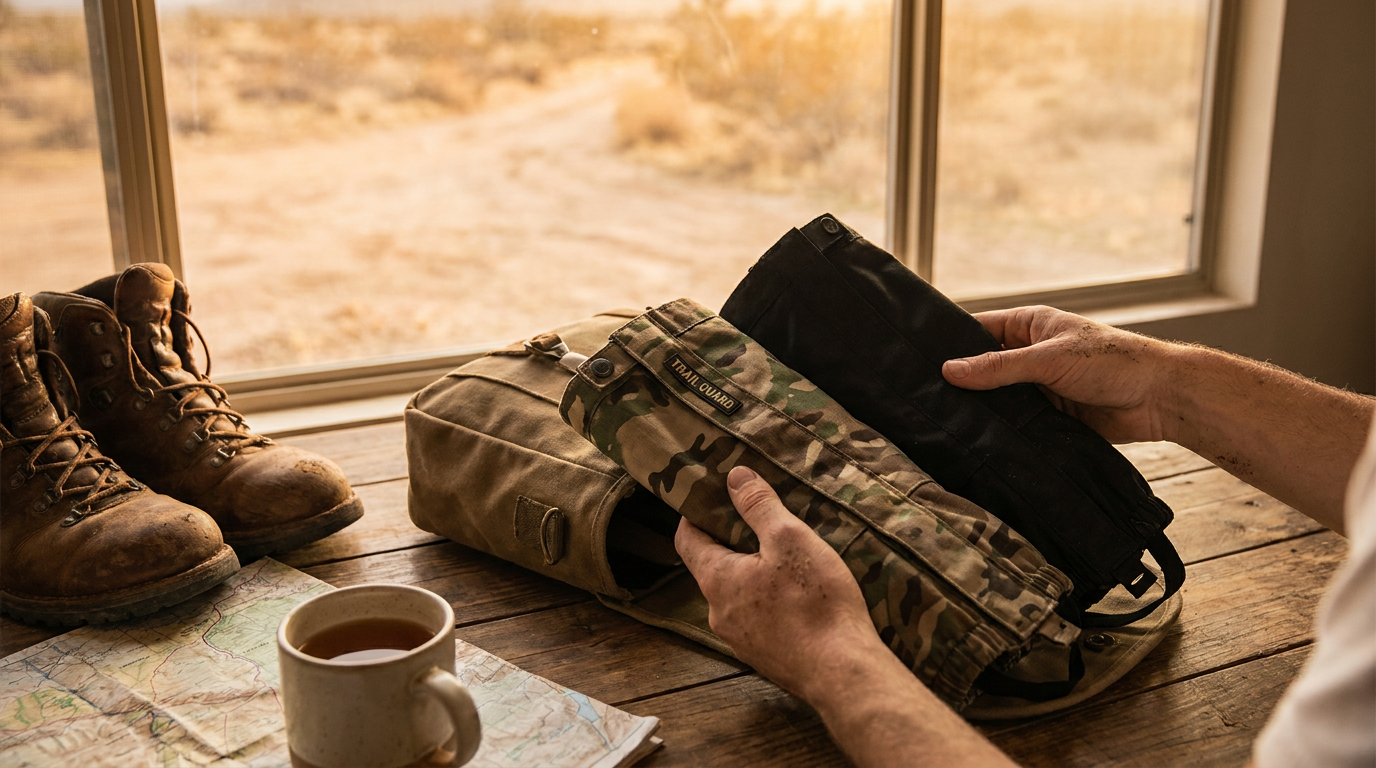
Trail Guard Gaiters for Summer Heat and Dust
 Daniel OkaforField Tester
July 23, 2026. This review examines how Trail Guard Gaiters manage heat and debris during high-temperature summer trekking. It is written for hikers and backpackers who need to keep grit out of their boots without overheating their lower legs.
The Summer Debris Problem
Summer hiking presents a specific set of challenges that differ significantly from winter mountaineering. While winter requires waterproof barriers, summer demands airflow and fine-particle filtration. According to Treeline Review, while knee-high nylon gaiters are appropriate for late-season snowpack or cold water crossings, they are often overkill for standard summer conditions. In my experience, wearing heavy, non-breathable protection in 90-degree heat leads to excessive sweating, which eventually causes socks to bunch and blisters to form. I tested this for three weeks across the dusty, sun-exposed trails of the high desert, where the primary enemy isn't moisture, but fine volcanic silt and sharp granite scree. Most hikers assume they need a waterproof membrane to stay protected, but as OutdoorGearLab notes when recommending the Dirty Girl Gaiter, a lightweight, breathable option is often the superior choice for thru-hiking and summer trail running. The goal is to create a seal that stops the 'sandpaper effect' inside the shoe without turning the ankle into a sauna.
Trail Guard Performance in the Heat
Photo by Maël BALLAND on Pexels
Day three is where I noticed the primary advantage of the Trail Guard construction. Many breathable running gaiters sacrifice durability for weight, but these managed to balance both. What surprised me was how the fabric handled the combination of sweat and fine dust; rather than becoming a mud-caked mess that stiffens up, the material allowed for enough moisture transfer to stay pliable. During a twelve-mile stretch through a burn scar with zero shade, my feet stayed significantly cooler than they did in the previous season when I used traditional heavy-duty nylon gaiters. I’ve found that optimizing Trail Guard Gaiters for ultralight running is largely a matter of ensuring the tension is set correctly before the heat of the day peaks. The fit is trim enough that it doesn't snag on low-lying brush, a common complaint with baggier models like the Rab Latok, which CleverHiker notes is comfortable but can sometimes feel loose. I found that the Trail Guard design avoids this bagginess, maintaining a close-to-skin profile that aids in heat dissipation. When I was moving through dense thickets, the outer face of the gaiter resisted pilling, which is a common failure point for summer-weight gear. This durability is essential when you are relying on Trail Guard Gaiters and the case for high-tension straps to keep the seal tight against the rand of the shoe. Here's the moment it earned its place: I took a sideways slide down a scree slope that should have shredded a lighter lycra gaiter, but the Trail Guard fabric held firm without a single puncture.
Choosing Your Summer Protection
Selecting the right gaiter for a summer objective requires a realistic assessment of the terrain versus the temperature. If you are strictly on-trail in well-maintained areas, a minimalist approach is best. However, for off-trail travel or areas with significant scree, you need a gaiter that won't migrate or ride up. What I'd do differently next time is swap to a thinner sock earlier in the day to fully take advantage of the gaiter's airflow. When evaluating options, consider that GORE-TEX is almost never the answer for summer unless you are specifically bushwhacking in rattlesnake habitat or dealing with constant wet brush. Instead, look for mechanical protection and high-tension security. To ensure you have the right setup for your next summer trip, use this framework:
- Prioritize fabric with a high CFM (Cubic Feet per Minute) rating to ensure maximum air movement.
- Verify that the attachment points are compatible with your specific footwear, especially if you use trail running gaiters with low-profile heels.
- Check for a reinforced inner ankle patch to prevent damage from 'self-kicking' on technical terrain.
- Ensure the top closure is adjustable but not restrictive, as leg swelling is common in high heat.
- Look for lightweight gaiters for trail running that utilize a durable under-shoe strap rather than just adhesive Velcro, which can fail in extremely hot, sandy conditions.
Sources

- Best Hiking Gaiters of 2026, Tested & Reviewed
- The Best Gaiters | Tested & Ranked
- Hiking and Backpacking Gaiters: Selection and Utilization